Session state at a glance
Track active Claude and Codex sessions, current tasks, completion, and waiting states from one compact notch panel.
ZackEyes turns the MacBook notch into a live command center for Claude Code and Codex CLI: sessions, tasks, rate limits, and permission prompts stay visible without stealing focus.
Less terminal hunting.
More agent awareness.
Always in sight.
When the agent starts, stalls, asks, finishes, or hits a limit, the signal appears where your eyes already are: the top edge of the screen.
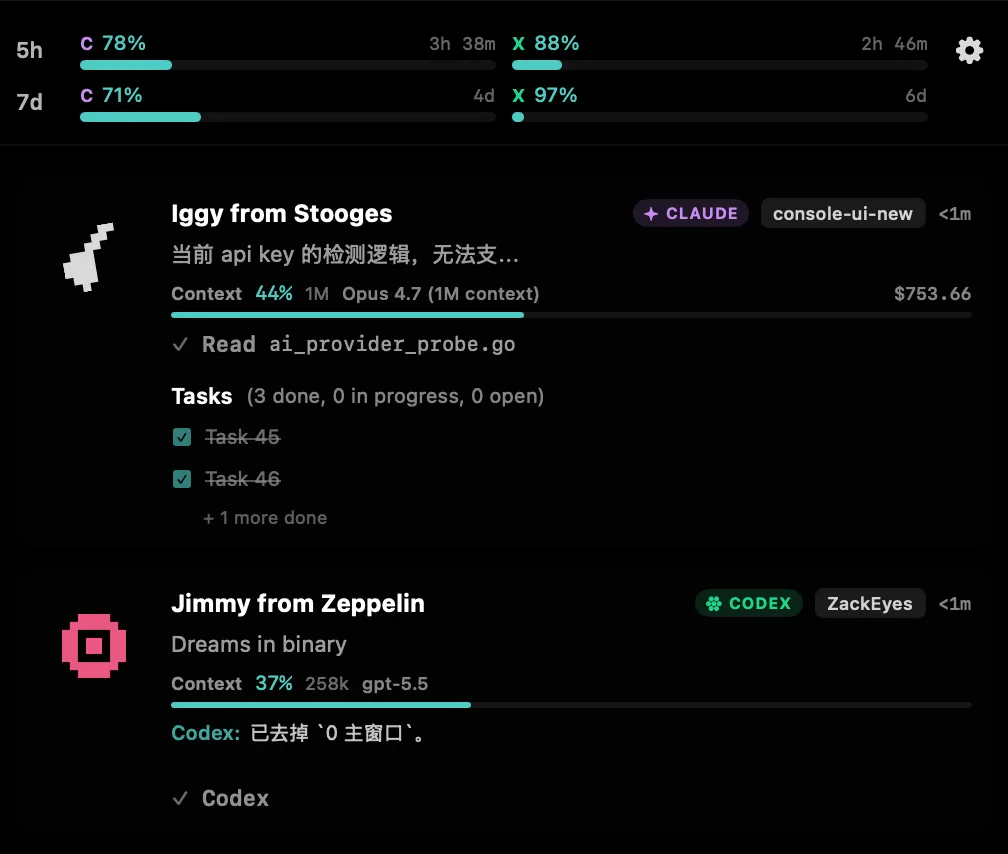
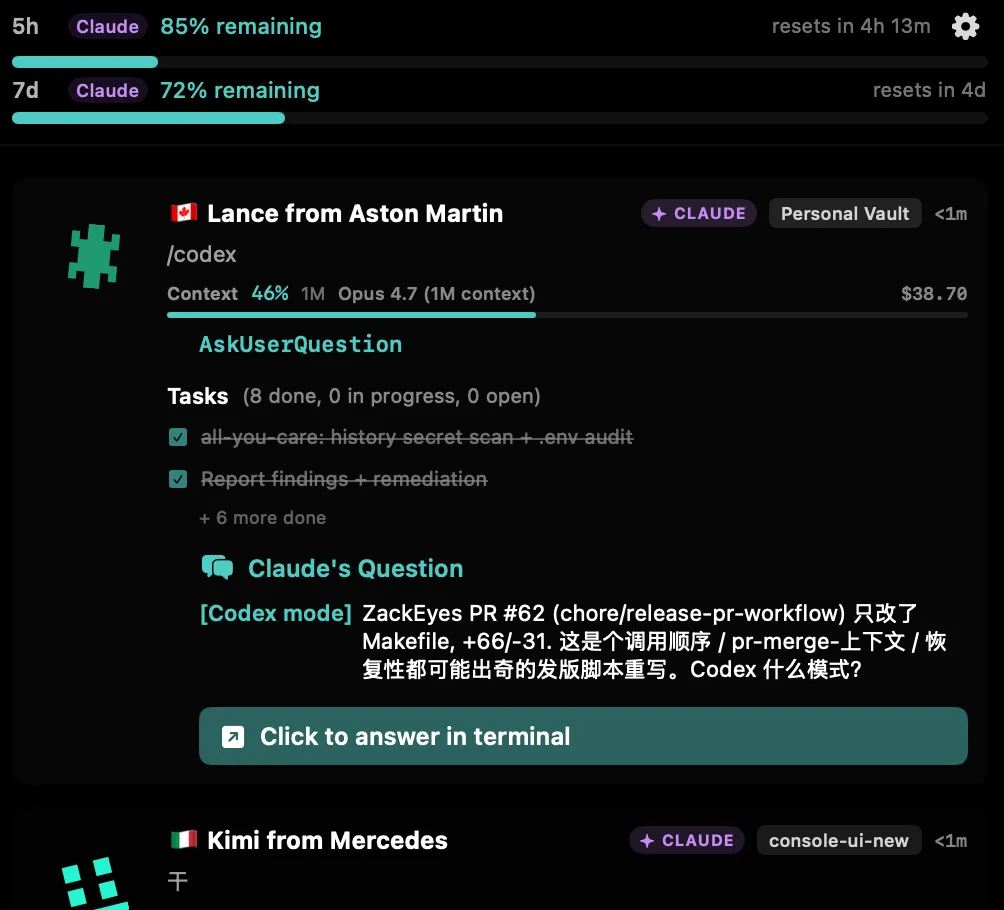
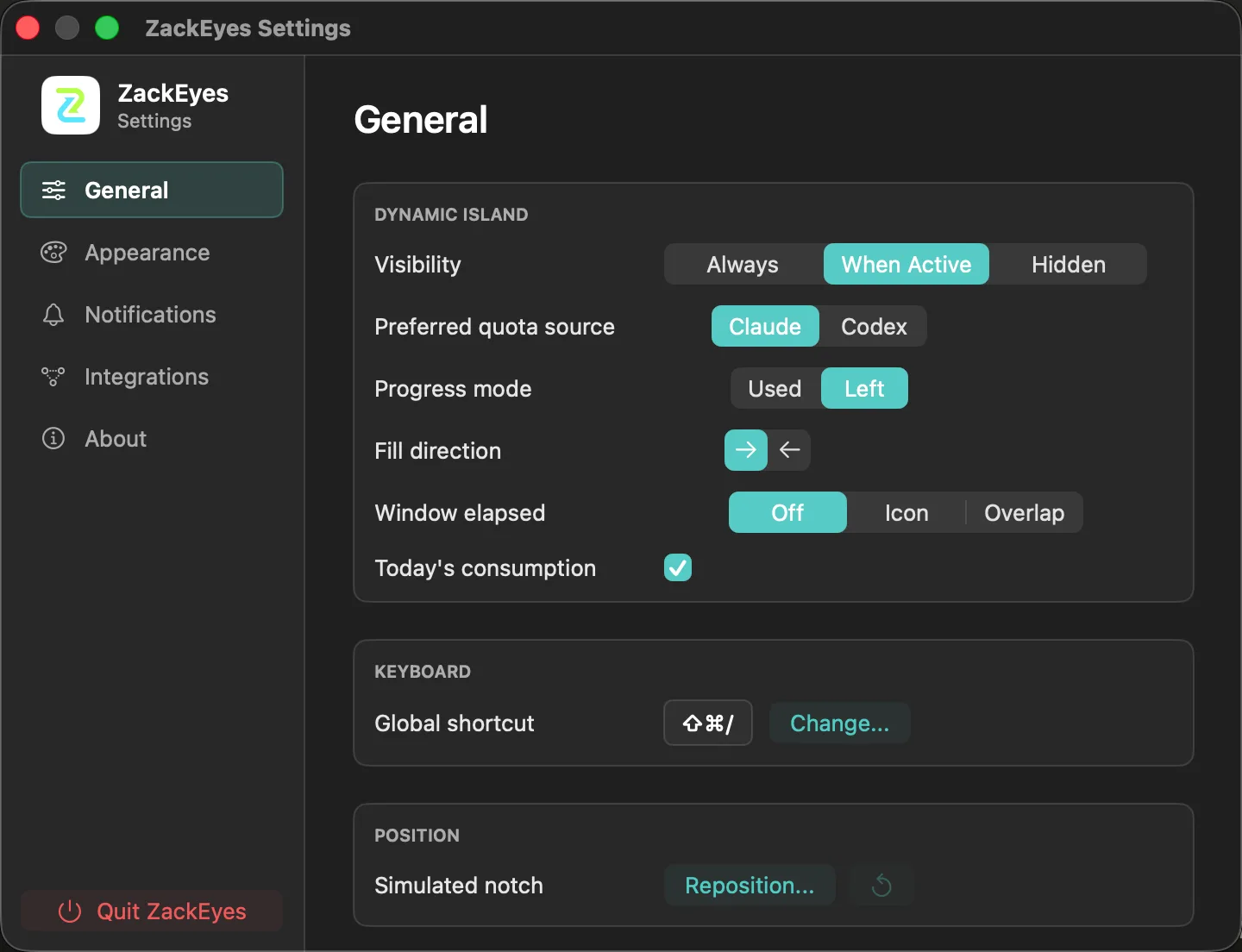
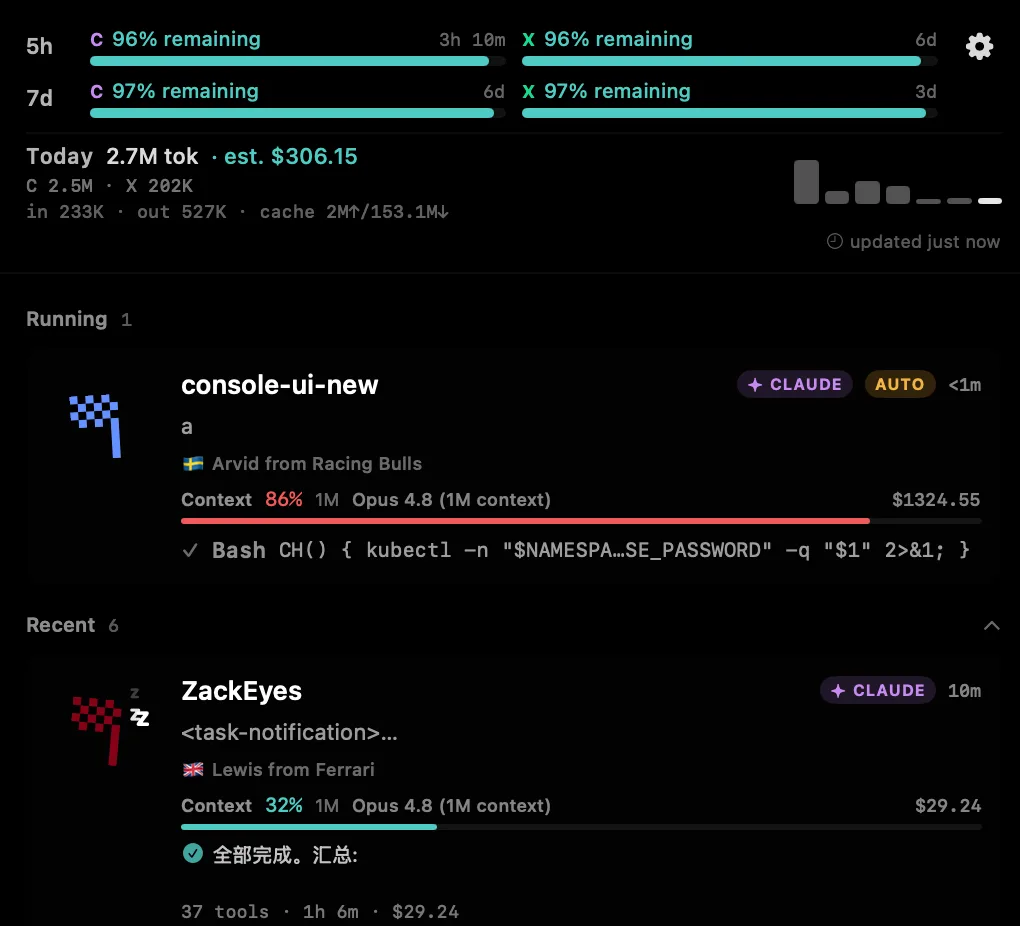
These are live ZackEyes surfaces — split Claude / Codex usage tracks, the terminal handoff, the unified Settings window, and attention-first session grouping in the same workflow.
ZackEyes is not another chat surface. It is a small operating layer for the moments when autonomous tools need your attention, but your editor should stay in front.
Track active Claude and Codex sessions, current tasks, completion, and waiting states from one compact notch panel.
Approve or deny sensitive tool calls from the panel. Claude AskUserQuestion prompts surface in the island and can send you straight back to the terminal answer path.
See 5-hour and 7-day usage pressure before a turn fails at the worst possible time.
Choose Rock Legends, F1 2026, AI Moguls, or Crayon Shin-chan themes with matching buddy names and custom notification sounds.
Use the physical notch when it exists, switch to a simulated Dynamic Island-style panel when it does not, and keep the same agent signals visible across desktop setups.
Tune the product around attention moments: pending approvals, task completion, stalled work, and useful usage pressure.
Click a session card to bring forward the matching iTerm2, Terminal.app, Ghostty, Warp, WezTerm, Kitty, Alacritty, VS Code, or Cursor tab. When nothing matches, the card says why instead of doing nothing.
See per-session context window pressure, model and cost metadata, and rate-limit tracks when the agent exposes them.
Use a custom global hotkey, hide or show the island, choose the compact agent display, and install updates through in-app DMG download.
A Today row tracks token spend and USD cost across Claude and Codex, with a 7-day sparkline. Model pricing is bundled and refreshed offline — no API key, no cloud calculation.
Open ports, git branch, uncommitted file count, what a dispatched Claude subagent is working on, and whether the agent is compacting its context rather than stalling. Ports come from kernel syscalls, not lsof.
The bridge speaks through Unix sockets, keeps agent hooks quiet when the app is closed, and leaves your terminal workflow intact.
ZackEyes is local-first by default. Read the privacy notes for what the website and app do outside your Mac.
$ claude code
hook SessionStart -> /tmp/zackeyes.sock
hook PreToolUse -> task visible in notch
ask PermissionRequest -> approve from panel
hook Stop -> notify when complete

$ codex
jsonl task_started -> live fallback
jsonl task_complete -> done
ZackEyes is MIT-licensed. Every hook installer, socket message, and notch animation lives in the open. Audit it, fork it, ship a competing notch — just don't break Claude Code.
Clear answers for installation, compatibility, privacy, and where product feedback should go.
ZackEyes is built for modern macOS desktop workflows and distributed as a DMG installer. If you hit a version-specific issue, report your macOS version and Mac model in GitHub Issues.
Yes. ZackEyes is designed as a companion for Claude Code and Codex CLI sessions, showing agent state, permission moments, task progress, and usage pressure near the MacBook notch.
ZackEyes is local-first by default. The website download flow uses GitHub Releases, and feedback goes through GitHub Issues, but the app does not need an account to show local agent status.
Use the ZackEyes release repository Issues page for bugs, install problems, compatibility reports, and product requests. Include your ZackEyes version, macOS version, agent CLI, and reproduction steps.
Yes. ZackEyes includes a simulated Dynamic Island-style panel for Macs without a physical notch, so desktop Macs and older MacBooks can still use the same agent awareness workflow.
ZackEyes is built for the macOS top-edge workflow. If behavior differs across built-in and external displays, file a GitHub Issue with the display setup and macOS version.
Yes. ZackEyes supports Rock Legends, F1 2026, AI Moguls, and Crayon Shin-chan themes, each with matching buddy names and notification sound choices.
ZackEyes can jump to the right terminal tab in iTerm2, Terminal.app, Ghostty, Warp, WezTerm, Kitty, Alacritty, VS Code, and Cursor when Accessibility permission is granted.
Hooks let ZackEyes receive local agent lifecycle, permission, task, and completion events without turning into a hosted dashboard. ZackEyes-managed hook commands include the string zackeyes so they can be identified later.
The bridge is designed to fail quietly and return control to the terminal workflow. Claude Code and Codex CLI should continue using their native behavior when ZackEyes is not available.
Download ZackEyes 0.9.6 for macOS, or use GitHub Issues for problems and feature requests.